
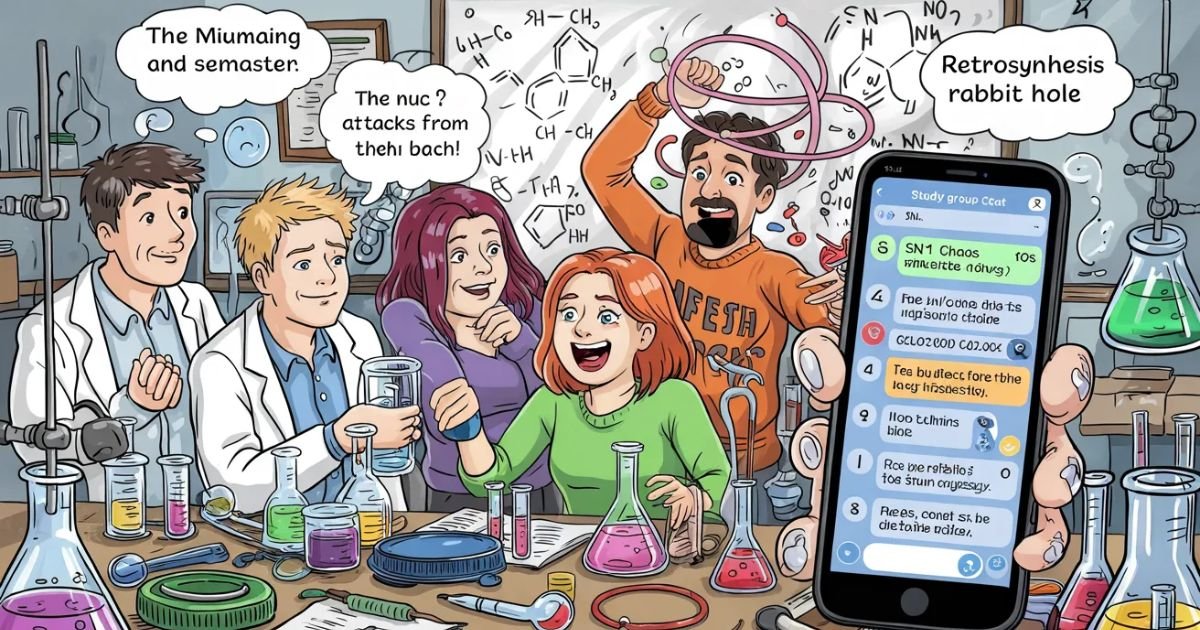

If you’ve ever walked into an organic chemistry classroom and felt like everyone around you was speaking a foreign language you weren’t imagining it. “Did you memorize the SN2 mech?” “The nuc just attacks from the back, relax.” “I’m deep in a retrosynthesis rabbit hole and I can’t get out.” Sound familiar? Welcome to the world of orgo slang, the unofficial language of one of America’s most feared college courses.
Whether you’re a first-year pre-med student, a curious STEM outsider, or someone who survived orgo and wants to relive the trauma this guide breaks it all down. Every term. Every origin. Every context where you’d actually use it.
What Is Orgo Slang?
Orgo slang is the informal vocabulary that students, TAs, and even professors have built around organic chemistry the branch of science focused on carbon-based compounds and their reactions. At its simplest, “orgo” is just a shortening of “organic chemistry.” But it doesn’t stop there.
The slang ecosystem stretches from reaction mechanism nicknames to emotional descriptors for exam-day panic. It’s alive, evolving, and surprisingly rich. Think of it less like a glossary and more like a dialect one spoken fluently in study group chats, Discord servers, and Reddit chemistry threads at 2 AM.
“Orgo isn’t just a class it’s a rite of passage. And like any rite of passage, it has its own language.”
The Origins of Orgo Slang
Nobody sat down and invented orgo slang. It grew organically, appropriately out of necessity.
University chemistry courses in the US, especially pre-med tracks, have long treated organic chemistry as the ultimate academic gauntlet. Students under pressure get creative. Shortening “organic chemistry” to “orgo” saved time and made the course feel slightly less terrifying. From there, the language expanded. Reactions got nicknames. Lab disasters got colorful descriptions. The SN1 reaction became “SN1 chaos.” The E2 elimination became just “elim.”
The internet supercharged everything. Reddit communities like and gave students a shared platform. TikTok OChem memes went viral. Discord study groups created real-time slang propagation. By the early 2020s, a student in Texas and a student in Maine were using the same orgo terminology without ever meeting.
Why Students Use Orgo Slang
There are real psychological reasons this language caught on so hard and so fast.
Solidarity. When you say “I’m deep in hell semester,” another orgo student instantly gets it. No explanation needed. That shorthand creates instant community and community is survival in a brutal organic chemistry course.
Humor as a coping tool. Turning “I completely bombed the SN2 mechanism question” into “I got absolutely SN2’d” makes failure survivable. Chemistry stress relief humor isn’t frivolous. It’s functional.
Efficiency. “Reags” beats “reagents.” “Mech” beats “reaction mechanism.” When you’re racing through a study session, every syllable counts.
Memory. This one surprises people. Associating a carbocation intermediate with “carbocation chaos” creates an emotional hook that plain terminology doesn’t. Cognitive science backs this up emotional context improves recall. That’s why memory aids in chemistry work so well when they’re funny or weird.
Read This Article: Tralalero Tralala Mean
Core Orgo Slang Terms and Their Meanings
Here’s your complete orgo slang reference the terms you’ll hear in every classroom, lab, and study group across the US.
The Master Orgo Slang Table
| Slang Term | Formal Meaning | Example in Context |
|---|---|---|
| Orgo | Organic Chemistry | “Orgo is trying to kill me this semester.” |
| Mech | Reaction Mechanism | “Draw the full mech every curly arrow.” |
| Nuc | Nucleophile | “The nuc attacks the electrophilic carbon.” |
| Elec | Electrophile | “Find the elec first, then figure out the nuc.” |
| Elim | Elimination Reaction | “Is this SN2 or elim? I can’t tell anymore.” |
| Reags | Reagents | “What reags do we need for this synthesis?” |
| Curly Arrows | Electron Movement Arrows | “Your curly arrows are going the wrong way.” |
| Grignard Attack | Grignard Reagent Reaction | “Grignard attack is my favorite move in synthesis.” |
| SN1 Chaos | SN1 Reaction Unpredictability | “Tertiary substrate? Expect full SN1 chaos.” |
| Proton Shuffle | Acid-Base Proton Transfer | “It’s just a proton shuffle don’t overthink it.” |
| Carbocation Chaos | Carbocation Rearrangement | “Watch for carbocation chaos with that substrate.” |
| Spectro | Spectroscopy (NMR/IR) | “Spectro section destroyed my exam score.” |
| Orgo Brain | Mental fog from over-studying | “Day five of studying full orgo brain mode.” |
| Hell Semester | Semester when you take orgo | “Sophomore hell semester almost broke me.” |
| Retrosynthesis Rabbit Hole | Getting lost in backwards synthesis | “Three hours in the retrosynthesis rabbit hole again.” |
| Chirality Crisis | Panic over stereochemistry | “I had a full chirality crisis on question four.” |
Terms Specific to Reactions and Mechanisms
The SN1 reaction and SN2 reaction generate the most slang probably because they’re the first major fork in the road for orgo students. Understanding substitution nucleophilic unimolecular vs. substitution nucleophilic bimolecular is genuinely hard. So students gave them personalities.
- SN1 = the chaotic one. It goes through a carbocation intermediate, produces a racemic mixture, and takes its sweet time. Students call it “SN1 chaos” because you never quite know what’s coming.
- SN2 = the sneaky back-attacker. It’s a concerted reaction one step, anti-periplanar geometry, clean inversion. Students say “the nuc attacks from the back” like it’s a chess move.
- E1 and E2 get lumped under “elim” in casual conversation. The distinction matters academically but in a study group at midnight, “elim vs. sub” is the whole debate.
Curly arrows deserve their own mention. These electron movement arrows show electron flow in a mechanism. Getting them wrong pointing them at a hydrogen instead of a lone pair, for example is one of the most common orgo mistakes. The phrase “your curly arrows are backwards” is a rite of passage in every orgo classroom.
Lab-Specific Orgo Slang
The lab has its own dialect within the dialect.
- TLC Race running a thin-layer chromatography plate to monitor a reaction. Competitive energy, lots of squinting at spots under UV light.
- Column of Doom flash column chromatography. Time-consuming, messy, and humbling for everyone.
- The Bump when a liquid bumps violently during distillation. Terrifying the first time. A dark joke by the fifth.
Related Terms and Alternatives
Orgo slang doesn’t exist in a vacuum. The same shortening instinct that gave us “orgo” also gave us inorgo (inorganic chemistry slang for “inorganic chemistry”), bio orgo (biochemistry slang for the overlap between biology and organic chemistry), and “biochem” for biochemistry proper.
Physics students say “thermo” and “E&M.” Biology students say “micro” and “physio.” It’s a STEM course jargon phenomenon high-pressure courses breed shorthand, and shorthand breeds community. The pattern is universal.
What’s interesting about orgo specifically is that its slang penetrates deeper into the subject matter itself. It’s not just a shortened course name it’s a full vocabulary of organic chemistry abbreviations and conceptual nicknames that actually map onto the chemistry being studied.
Orgo Slang in Action: Real Examples
Reading definitions is one thing. Seeing the slang flow naturally is another.
Study Group Chat:
“Okay the nuc attacks from the back in SN2 clean inversion, no carbocation chaos. Does everyone get that before we move to elim?”
Text Exchange:
“Surviving hell semester?” “Barely. Full orgo brain. The chirality crisis on last week’s quiz was real. Please tell me there’s a curve.”
Reddit Post (r/premed style):
“Six hours in a retrosynthesis rabbit hole and I’ve forgotten what sunlight looks like. Reags are mocking me. Send help and also a Grignard reagent.”
In-Class (Professor, surprisingly):
“Don’t go down the mechanism maze without drawing your curly arrows first. I mean it.”
Each of these examples shows academic slang in science doing real work building connection, communicating efficiently, and making a brutal subject feel survivable.
The Cultural Impact of Orgo Slang
OChem student culture is genuinely fascinating as a social phenomenon. Orgo slang functions as academic community bonding a shared language that marks membership in a tribe of survivors.
Chemistry memes and STEM humor around orgo have gone fully mainstream. TikTok’s #studytok community spread orgo terminology explained content to millions of viewers who’d never taken the course. The “orgo is trying to kill me” format became practically its own genre. This is viral chemistry memes culture at its most organic (sorry, couldn’t resist).
What’s remarkable is the accuracy embedded in the humor. A meme about carbocation racemization or proton abstraction that makes you laugh probably also helps you remember the concept. That’s not a coincidence. It’s STEM humor doing educational heavy lifting without announcing itself.
When and How to Use Orgo Slang
Context is everything here.
✅ Use orgo slang freely in:
- Study groups and peer tutor sessions
- Reddit chemistry threads and Discord study groups
- Casual conversation with classmates and TAs
- Science communication content (YouTube, TikTok, podcasts)
- Instagram science humor captions
❌ Avoid orgo slang in:
- Lab reports and formal write-ups
- Professional emails to professors
- Research internship applications
- Academic publications
The rule of thumb is simple if it would sound weird in a formal presentation, save the slang for the study group chat. Most professors appreciate the humor but expect clean organic chemistry terminology when it counts.
How to Respond to Orgo Slang
If you’re new to the course and someone drops “the nuc attacks the elec” into conversation don’t panic. Ask. Upperclassmen love explaining orgo slang to freshmen. It’s practically a bonding ritual.
Online, searching any slang term on Reddit or a chemistry Discord will get you a clear answer within minutes. The online study communities built around orgo are remarkably welcoming precisely because everyone remembers being the confused newcomer.
Once you’re comfortable use it back. Responding with the right classroom shorthand signals that you belong. And in a course as isolating as orgo can feel, belonging matters.
Common Misconceptions
“Orgo slang is lazy language.” Not even close. It’s efficient, community-building communication. Linguists would recognize it as functional shorthand the same impulse that gives us “ASAP” and “FAQ.”
“Only struggling students use it.” Top students are often the most fluent in orgo slang because they’re the most embedded in study culture.
“It’s a new internet thing.” Campus-based orgo slang predates the internet by decades. Reddit and TikTok amplified it they didn’t invent it.
“Slang means you don’t take it seriously.” Some of the most slang-fluent students are also the most rigorous. Informal language and academic excellence aren’t mutually exclusive.
Frequently Asked Questions
Can I use Orgo slang professionally?
Generally, no keep professional emails and publications formal. However, science communicators on YouTube and TikTok use orgo class slang deliberately and effectively. Know your audience.
How did Orgo slang become popular online?
Reddit communities like r/premed were early hubs. TikTok chemistry memes and Discord study groups spread the slang to millions of students. By 2020, it was fully mainstream in online study communities.
What is the exact Orgo definition?
“Orgo” is informal shorthand for organic chemistry the study of carbon-based compounds and their reactions. Culturally, it also implies the shared experience of taking one of the hardest university chemistry courses in the US curriculum.
Are there equivalents in other subjects?
Absolutely. “Inorgo,” “bio orgo,” “biochem,” “physio,” “thermo” STEM course jargon follows the same shortening and nicknaming patterns across disciplines. Even law school has its own dense slang ecosystem.
Can Orgo slang help me study or remember concepts?
Yes and there’s cognitive science behind it. Emotional and contextual associations improve memory retrieval. Calling a carbocation intermediate “carbocation chaos” creates a memorable mental image. Pair slang-based memory tricks with spaced repetition and active recall for best results.
Conclusion
From that bewildered freshman hearing “nuc attacks from the back” for the first time, to the confident junior who dreams in curly arrows and thinks in reaction mechanisms orgo slang marks the journey. It’s not trivial. It’s a living language built by real students navigating real difficulty, and it carries genuine value: community, efficiency, humor, and surprisingly effective memory hooks.
Whether you’re hunting for an organic chemistry study guide, trying to decode your study partner’s texts, or just curious about OChem definitions and science student slang you’re now fluent. Use it wisely, use it often, and for the love of all things carbon-based, always draw your curly arrows in the right direction.
Welcome to the orgo club. The carbon skeletons are plentiful and we hope the curve is generous.
