
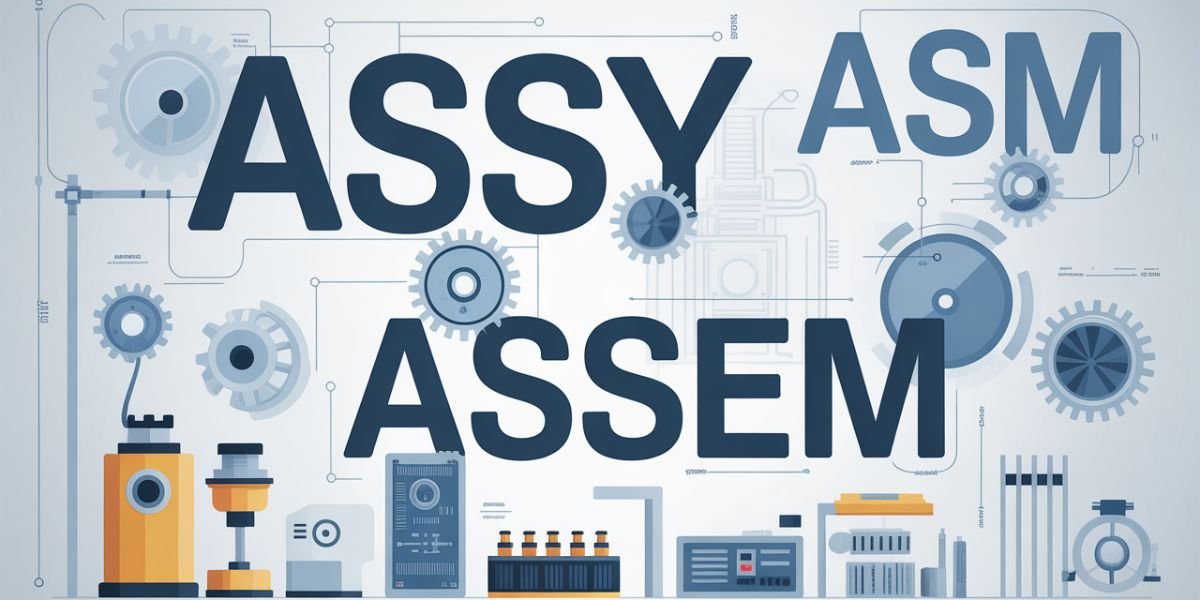

Ever stared at a technical drawing and wondered what “ASSY” means? You’re not alone. The abbreviation for assembly pops up everywhere—manufacturing floors, engineering blueprints, workshop notes. Let’s crack this code together.
Assembly abbreviations save space and time. But which one should you use? ASSY, ASM, or ASSEM? Each serves specific contexts in American English technical writing.
What is the Abbreviation for Assembly?
The assembly short form comes in three flavors. ASSY dominates manufacturing documentation and mechanical drawings. ASM appears in programming and computer science contexts. ASSEM suits formal engineering reports and aerospace documentation.
Manufacturing assembly professionals favor ASSY overwhelmingly. You’ll spot it on product labels and factory assembly instructions. Engineers use it for component assembly documentation daily.
Common Abbreviations
Here’s your quick reference guide:
- ASSY – Most popular in industrial assembly process
- ASM – Standard in assembly language programming
- ASSEM – Preferred for formal academic technical writing
| Abbreviation | Primary Use | Industry |
|---|---|---|
| ASSY | Manufacturing | Automotive, Electronics |
| ASM | Programming | Software Development |
| ASSEM | Formal Docs | Aerospace, Defense |
The assy abbreviation appears on blueprints constantly. ASM meaning extends beyond engineering—it’s also American Society for Microbiology. Context clarifies everything.
When to Use These Abbreviations
Technical abbreviations follow industry standards strictly. Manufacturing documentation uses ASSY for product assembly instructions. Software engineers write ASM for assembly language code.
Blueprint terminology demands consistency always. First mention requires full spelling: “assembly (ASSY)”. Subsequent references can abbreviate safely. Engineering abbreviations maintain professional credibility when used correctly.
Workshop terminology embraces shortcuts naturally. Shop floor workers understand ASSY immediately. But client-facing documents need complete words.
Read This Article: Science Words That Start With R:
What Does Assembly Mean?

Assembly definition covers multiple meanings. In manufacturing, it’s the fabrication process of joining components. The product design terms describe creating functional units from parts.
Mechanical assembly involves fitting components together precisely. Industrial design language emphasizes the construction and fabrication aspects. Engineers focus on the manufacture workflow entirely.
Beyond manufacturing, assembly describes gatherings—legislative bodies, school meetings, religious congregations. The assembly process transforms individual parts into complete products.
Synonyms for Assembly
Looking for alternatives? Try these:
- Fabrication – creating through manufacturing process
- Construction – building from components
- Manufacture – industrial production workflow
- Gathering – bringing elements together
- Conference – organized meeting context
Manufacturing terminology offers rich vocabulary options. Construction and fabrication terms overlap significantly. Production process descriptions benefit from varied word choices.
How to Pronounce Assembly
The assembly pronunciation follows this pattern: /ə-ˈsem-blē/. Stress hits the second syllable hard—”uh-SEM-blee”. American pronunciation differs slightly from British English variations.
Three syllables total: as-sem-bly. How to pronounce assembly correctly? Emphasize “SEM” naturally. Technical term pronunciation matters in professional settings.
When speaking abbreviations aloud, spell them: “A-S-S-Y”. Nobody says “assy” as one word. Professional technical terms maintain formality through spelling.
The History of the Word “Assembly”

Assembly word origin traces to Old French. “Assembler” meant bringing things together. Late Middle Ages English adopted the term broadly.
The assembler meaning evolved with industrial revolution. Factory assembly lines transformed the word permanently. Manufacturing communication standardized around these concepts.
Henry Ford revolutionized product assembly in America. Modern industrial assembly process owes everything to those innovations. Engineering documentation formalized abbreviation usage throughout 1900s.
Usage of Assembly Abbreviation in Context
Industry-specific abbreviations vary by sector. Manufacturing uses ASSY on mechanical drawings universally. Technical documents demand precision and consistency.
For Formal Writing
Academic technical terms require full spelling initially. Professional technical writing introduces abbreviations properly: “assembly (ASSY)”. Engineering reports maintain this standard religiously.
Formal vs informal abbreviations differ significantly. Industry communications with clients need clarity. Documentation clarity trumps brevity in critical contexts.
For Informal Writing
Workshop notes embrace shortcuts freely. Factory assembly workers text “ASSY” constantly. Internal team communications prioritize speed naturally.
Industrial shorthand works perfectly among colleagues. Quick messages between engineers abbreviate everything. Context makes meanings crystal clear.
Example Sentences with Abbreviations
Real-world assembly abbreviation examples clarify usage:
- “Install front ASSY before proceeding further.”
- “ASM code optimization improves performance significantly.”
- “Review ASSEM documentation in section four.”
- “Order replacement ASSY from supplier immediately.”
- “Update ASM listing with latest revisions.”
Blueprint abbreviations appear in technical specifications constantly. Manufacturing workflow documents abbreviate naturally throughout.
Abbreviation vs Full Word
Clear technical communication balances efficiency with understanding. Use full “assembly” for safety instructions. Assembly abbreviation usage works for internal documentation.
Space-constrained product packaging needs abbreviations desperately. Database fields limit characters strictly. Components and parts assembly listings abbreviate by necessity.
Assembly as an Acronym (Other Meanings)

ASM acronym meaning extends beyond engineering. American Society for Microbiology uses ASM officially. Legislative assembly abbreviation serves government contexts.
Assembly language meaning dominates computer science. ASM programming creates low-level code. Asm computer science courses teach fundamental concepts.
Advantages and Disadvantages of Using Assembly Abbreviation
Engineering short forms offer clear benefits:
Advantages:
- Space savings on technical drawings
- Faster documentation creation speed
- Industry standards compliance naturally
- Database optimization through brevity
Disadvantages:
- Potential confusion for newcomers
- Translation difficulties internationally
- Ambiguity in multiple contexts
- Training burden for teams
Manufacturing process terms require careful consideration. Balance efficiency against comprehension always.
FAQs
What’s the most common abbreviation for assembly? ASSY dominates manufacturing and engineering documentation.
Is ASM correct for assembly? Yes, especially in programming contexts.
When to use ASSY? Use it for industrial assembly process documentation.
Difference between ASSY, ASM, and ASSEM? Context determines choice—manufacturing, programming, or formal writing.
Conclusion
Understanding assembly abbreviation meaning enhances professional communication. ASSY abbreviation serves manufacturing perfectly. ASM abbreviation suits technical programming contexts. ASSEM abbreviation works for formal documentation needs.
Manufacturing terminology demands precision and consistency. Choose abbreviations based on audience expertise. When uncertain, spell assembly completely.
Master these product design terms today. Your technical documentation terms improve dramatically. Professional technical writing requires this knowledge absolutely.
Start applying these conventions immediately. Your engineering documentation becomes clearer instantly. Assembly in manufacturing communication reaches new effectiveness levels.
