


Picture this: You’re stuck in traffic. Horns blare around you. Your meeting starts in ten minutes. How do you feel? Definitely not calm.
Language gives us precise tools to express these moments. Understanding the opposite of calm helps you communicate exactly what you’re experiencing. Whether you’re anxious about a presentation or describing a chaotic situation, choosing the right word matters.
Let’s explore the rich vocabulary that captures everything calm isn’t.
Meaning of Calm
Calm describes a state of peace. It means tranquility, composure, and emotional steadiness. When you’re calm, your mind feels clear. Your body relaxes naturally.
The word comes from Greek “kauma” meaning heat. Sailors adopted it to describe still seas. Over time, it evolved to describe inner peace too.
Calm appears in three main contexts:
| Context | Meaning | Example |
|---|---|---|
| Emotional | Inner peace and mental clarity | Sarah felt calm before her exam |
| Environmental | Quiet and still surroundings | The calm ocean reflected the sunset |
| Behavioral | Composed and controlled demeanor | He remained calm during the crisis |
You can be calm emotionally while surrounded by noise. Or you might inhabit a calm environment but feel anxious inside. Context shapes which meaning applies.
Why Knowing the Opposite of Calm Matters
Your vocabulary shapes how others understand you. When you say “I’m not calm,” people wonder what you actually mean. Are you stressed? Anxious? Furious?
Precision prevents misunderstandings. Your boss needs to know whether you’re mildly concerned or completely overwhelmed. Your doctor wants to hear whether you feel uneasy or panicked.
Beyond practical communication, these words build emotional intelligence. Recognizing the difference between nervous and agitated helps you process your feelings accurately. You can’t address what you can’t name.
Writers benefit enormously from this vocabulary. Compare these sentences:
- “The crowd wasn’t calm.”
- “The frenzied crowd pushed through the gates.”
The second paints a vivid picture. It shows rather than tells.
Read This Article: Tools That Start With I
Antonyms of Calm with Meaning And Example
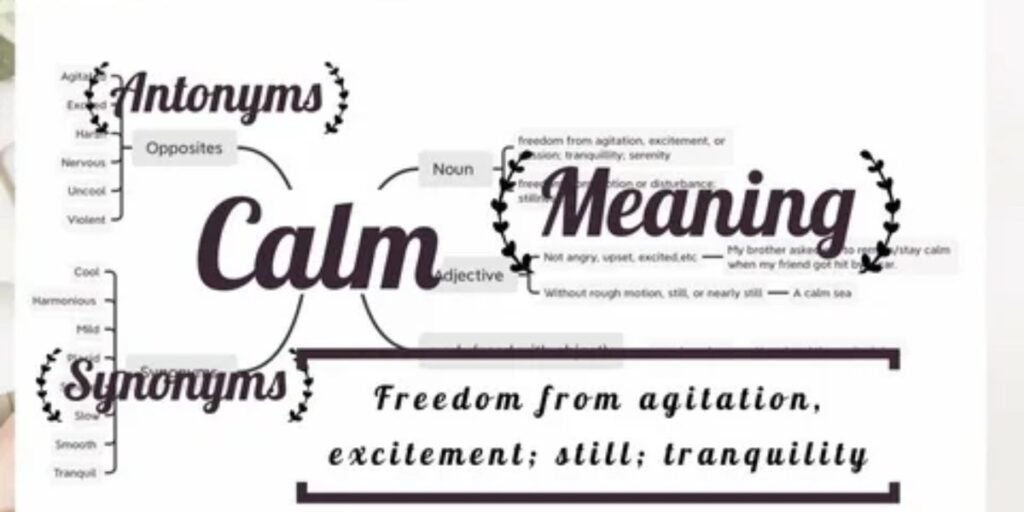
Here’s your comprehensive guide to calm’s opposites. Each word carries unique shades of meaning. Choose wisely based on your specific situation.
| Antonym | Meaning | Example Sentence |
|---|---|---|
| Agitated | Disturbed and unable to relax | The agitated patient paced the waiting room |
| Anxious | Worried about uncertain outcomes | She felt anxious before her presentation |
| Nervous | Apprehensive and jittery | His nervous laughter revealed his discomfort |
| Restless | Unable to remain still | The restless child fidgeted throughout dinner |
| Troubled | Distressed and worried | He looked troubled after the phone call |
| Frantic | Wildly desperate and panicked | Frantic shoppers rushed through Black Friday sales |
| Chaotic | Completely disorganized and confused | The chaotic scene resembled a disaster zone |
| Turbulent | Violently agitated and unstable | Turbulent winds rattled the windows all night |
| Upset | Emotionally disturbed and distressed | The upset customer demanded a refund |
| Volatile | Liable to change unpredictably | Her volatile temper scared coworkers away |
Additional opposites include excited, hectic, wild, rough, panicked, disturbed, unsettled, flustered, and perturbed. Each serves specific contexts and situations.
Emotional Antonyms of Calm
Emotions live inside your head and heart. These antonyms of calm describe internal psychological states rather than external appearances.
Anxious tops the list for most people. Anxiety involves worry about future outcomes. Your heart races. Your palms sweat. Thoughts spiral about everything that could go wrong. “Jane felt anxious about her medical results” captures that anticipatory dread perfectly.
Agitated suggests visible restlessness combined with emotional disturbance. You can’t sit still. Your mind won’t settle. “The agitated witness struggled to answer questions coherently” shows how inner turmoil affects outward behavior.
Nervous describes temporary, situation-specific unease. Most people get nervous before public speaking or first dates. It’s less intense than anxiety. “Tom gets nervous before every presentation” indicates a recurring but manageable feeling.
Distressed carries more weight. It implies significant emotional pain or suffering. You’d use it for serious situations. “She was distressed by the tragic news” respects the gravity of genuine grief.
Worried sits somewhere between concerned and anxious. It involves continuous thinking about potential problems. “Parents worried about their child’s safety” reflects ongoing mental unease without crossing into panic.
Quick reference for emotional opposites:
- Fearful – experiencing dread or terror
- Tense – strained and unable to relax
- Stressed – overwhelmed by external pressures
- Panicked – sudden uncontrollable fear
- Overwrought – extremely agitated emotionally
Behavioral Antonyms of Calm
Behavior is what others observe. These antonyms describe how people appear externally, regardless of internal feelings.
Frantic behavior involves wild, uncontrolled actions. Someone frantic moves desperately and hurriedly. “Frantic efforts to find the lost child” shows emergency-driven behavior that others can clearly see.
Restless people can’t stay still. They fidget constantly. They pace. They shift positions repeatedly. “The restless audience shuffled in their seats” describes observable physical movement driven by boredom or discomfort.
Flustered combines confusion with agitation. You become flustered when rushed or embarrassed. Your thinking gets muddled. “She became flustered during the job interview” explains visible confusion under pressure.
Erratic describes unpredictable behavior patterns. No consistency exists. Actions seem random. “His erratic driving concerned other motorists” points to observable instability that creates safety concerns.
Volatile people shift moods rapidly and unpredictably. They might seem fine one moment and explode the next. “Her volatile temper made coworkers walk on eggshells” describes a behavioral pattern others must navigate carefully.
| Behavioral Opposite | Observable Signs | Typical Context |
|---|---|---|
| Frantic | Rushed movements, wide eyes | Emergencies |
| Restless | Fidgeting, pacing, tapping | Waiting periods |
| Flustered | Stammering, blushing, confusion | Social pressure |
| Erratic | Unpredictable actions | Instability |
| Volatile | Sudden mood shifts | Temperament issues |
Environmental Antonyms of Calm
Environments affect how we feel. These words describe physical surroundings and atmospheres rather than people.
Turbulent captures violent motion and disorder. Weather forecasters use it for rough air. Financial analysts describe market volatility this way. “Turbulent seas made sailing impossible” paints a picture of dangerous water conditions.
Chaotic means complete disorder. No organization exists. Confusion reigns. “The chaotic traffic caused massive delays” describes a transportation system breaking down into randomness.
Stormy applies literally to weather and metaphorically to situations. Dark clouds, strong winds, and precipitation characterize stormy weather. “Stormy weather postponed the outdoor wedding” uses the literal sense. “Their stormy meeting ended with shouting” employs the metaphorical.
Rough describes harsh, ungentle conditions. Ocean conditions, terrain, or experiences can all be rough. “Rough seas tossed the boat violently” focuses on physical environmental challenges.
Wild suggests untamed, uncontrolled natural forces. “Wild winds uprooted trees across town” describes nature’s power unleashed without restraint.
Additional environmental descriptors:
- Tempestuous – violently agitated atmosphere
- Unsettled – changeable and restless conditions
- Choppy – short irregular waves
- Tumultuous – loud and disorderly crowds
Usage Rules for Antonyms of Calm
Context determines which opposite works best. Follow these guidelines for precise word choice.
Rule #1: Match intensity to reality. Don’t exaggerate. Mild situations need mild words like nervous or uneasy. Moderate situations call for anxious or agitated. Save frantic and hysterical for genuinely severe circumstances.
Rule #2: Know your audience. Professional settings require formal vocabulary. Say “anxious” rather than “freaking out” in business emails. Academic writing demands precision. Casual conversations allow flexibility.
Rule #3: Separate emotional from environmental. Don’t mix categories carelessly. People feel anxious. Oceans are turbulent. Saying “the anxious ocean” creates confusion.
Rule #4: Consider duration. Temporary states include nervous, flustered, and startled. Ongoing conditions are stressed, troubled, and worried. Chronic patterns show up as volatile, erratic, and unstable.
| Low Intensity | Medium Intensity | High Intensity |
|---|---|---|
| Uneasy | Anxious | Panicked |
| Restless | Agitated | Frantic |
| Concerned | Worried | Distressed |
Common Mistakes When Using Antonyms of Calm
Everyone makes vocabulary errors. Avoid these frequent pitfalls.
Mistake #1: Overusing “anxious” for everything. Not every uncomfortable feeling equals anxiety. Restlessness during boring meetings isn’t anxiety. Eagerness for vacation isn’t anxiety either.
Wrong: “I’m anxious to start my vacation!” Right: “I’m eager to start my vacation!”
Mistake #2: Choosing dramatic words for mild situations. Exaggeration undermines credibility. Don’t say you’re hysterical about a typo. Slightly flustered works better.
Mistake #3: Mixing environmental and emotional terms incorrectly. Personalities aren’t turbulent. Moods are volatile. Get the categories right.
Wrong: “Her personality was turbulent and chaotic.” Right: “Her moods were volatile and unpredictable.”
Mistake #4: Ignoring professional contexts. “The CEO was totally freaking out” sounds unprofessional. “The CEO appeared visibly concerned” maintains appropriate tone.
Antonyms of Calm Quiz
Test your understanding with these questions. Answers appear at the end.
Question 1: The ________ customer demanded immediate attention. A) calm B) agitated C) peaceful D) serene
Question 2: Which word describes rough ocean conditions? A) anxious B) nervous C) turbulent D) worried
Question 3: Which shows the HIGHEST distress level? A) uneasy B) concerned C) frantic D) restless
Question 4: Most appropriate for business communication? A) “Markets are freaking out” B) “Markets show volatility”
Question 5: Which describes internal emotional state? A) “John felt turbulent” B) “John felt anxious”
Answer Key: 1-B, 2-C, 3-C, 4-B, 5-B
Scoring: 5/5 = Expert! 3-4/5 = Good grasp. 0-2/5 = Review needed.
FAQs
What’s the most common opposite of calm? Anxious takes the top spot. It applies broadly to worried, uneasy feelings about uncertain outcomes.
Can “excited” be an opposite? Yes, in terms of energy level. Excitement represents heightened arousal. However, it’s typically positive while calm’s opposites usually carry negative connotations.
What’s the difference between nervous and anxious? Nervous describes temporary, situation-specific unease. Anxious implies deeper worry that lingers longer and feels more intense.
How do I choose the right antonym? Consider three factors: intensity level, context type, and audience expectations. Match word strength to situation severity.
Is “stressed” an opposite of calm? Absolutely. Stress represents feeling overwhelmed by pressure. Many people use it in daily conversation.
Conclusion
Mastering the opposite of calm transforms your communication. You gain precision. Others understand you better. Your writing becomes more vivid.
Remember the three main categories: emotional (anxious, nervous), behavioral (frantic, restless), and environmental (turbulent, chaotic). Each serves specific purposes.
Practice using these antonyms in daily conversations. Notice which words others choose. Pay attention to context and intensity. Your vocabulary will expand naturally.
Language gives us power to express exactly what we experience. Use these opposites wisely. Choose words that match reality. Watch how people respond more appropriately when you communicate with clarity.
Now you’ve got the tools. Start applying them today.
