


Ever gotten stuck on a crossword clue and realized you can’t name a single science word that starts with J? You’re not alone. J is one of the rarest letters to kick off an English word, so when a science term does start with it, that word tends to be memorable, weird, or both.
This guide rounds up science words starting with J from every major field: physics, chemistry, biology, astronomy, earth science, medicine, and technology. Whether you’re a student building a science glossary, a teacher hunting for classroom science vocabulary, or just someone who loves quirky scientific terminology, you’ll find something useful here. Let’s dig in.
Why Do Science Words Starting With J Matter?
Here’s a fun fact: J ranks among the least-used letters to start an English word, right up there with Q, X, and Z. That scarcity is exactly why J letter science words stand out. A rare term sticks in your memory longer than a common one, which makes this list genuinely handy for vocabulary building.
There’s also a practical side. Students studying for exams need a student science glossary that covers every letter, not just the easy ones. Teachers building science learning resources often skip J because good material is hard to find. ESL learners working through ESL science vocabulary benefit from seeing these words grouped by subject instead of scattered across a dictionary. And if you’re into Scrabble, trivia night, or content writing, a solid list of J science terms is basically a cheat code.
So whether your goal is scientific literacy, classroom prep, or just curiosity, this list of science dictionary J words covers the bases. Now, onto the actual terms.
Physics Science Words That Start With J
Physics gives us some of the most important J science terms in the entire language, starting with a unit you’ve probably used without thinking twice about it.
Joule is the SI unit of energy, named after physicist James Prescott Joule, who spent years studying the relationship between heat and mechanical work. One joule equals roughly the energy needed to lift a small apple one meter off the ground. It shows up everywhere: your food’s calorie count, your phone battery’s rating, and the output of a nuclear reactor all trace back to this single energy measurement unit.
From that one name, physics built an entire vocabulary:
| Term | What It Means |
|---|---|
| Joule’s Law | Describes how electrical resistance heating produces heat proportional to current squared, resistance, and time |
| Joule Heating | The process by which an electric current passing through a conductor produces thermal energy |
| Joule Heating Equation | The mathematical formula (Q = I²Rt) used to calculate that heat output |
| Joule–Thomson Effect | The temperature change of a real gas when it expands without doing external work the science behind refrigeration |
| Joule–Thomson Coefficient | The number that predicts whether a gas expansion process cools or warms the gas |
| Joule Expansion | A gas expansion process into a vacuum with no heat exchange |
| Joule per Mole | A unit used in thermodynamics to express bond energy and reaction energy |
Beyond the Joule family, physics hands us several more standout terms. The Josephson Effect, and the related Josephson Junction, describe a quantum tunneling phenomenon where electric current flows between two superconductors separated by a thin barrier. This concept sits at the heart of modern superconductivity concepts and even shows up in ultra-precise voltage standards.
A junction diode, by contrast, belongs to everyday electrical circuit terms it’s a semiconductor device that lets current flow in one direction only.
Then there’s jerk, the rate of change of acceleration (think of that sudden lurch when an elevator starts moving). Jitter measures unwanted timing variation in electrical signals, a headache for engineers working with digital signal timing. Jamming, and the related jamming transition, describe how densely packed particles suddenly lock into place, a concept borrowed for everything from traffic studies to electronic interference in signal processing.
Rounding out the list: the Jacobian and Jacobian Matrix handle coordinate transformation in advanced physics and math; Johnson noise describes the random electrical noise generated by thermal agitation of electrons; and the J-Integral is a key tool in fracture mechanics, used to measure the energy release rate around a crack tip.
Read This Article: ORGO
Chemistry Science Words That Start With J
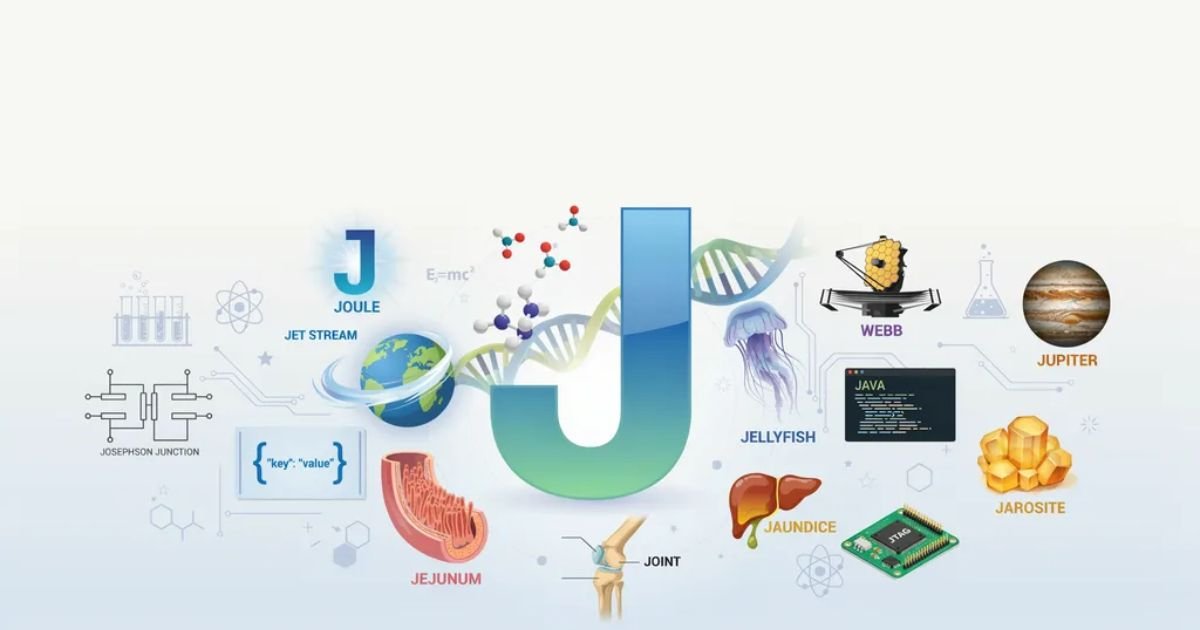
Chemistry’s J science terms are fewer in number but pack plenty of punch.
- Jahn–Teller Effect: describes how certain molecules distort their geometry to lower their energy a cornerstone concept in molecular distortion and coordination chemistry.
- Jarosite: a yellowish mineral compound containing iron and sulfate, often studied in geochemistry and even found on Mars.
- Jones Reagent: a chromium-based oxidizing agent used in organic chemistry labs to convert alcohols into aldehydes or ketones.
- Jasmonic Acid: a plant hormone involved in defense responses, bridging chemistry and biology.
- Jellification: the process by which a liquid transforms into a gel, relevant to colloidal systems and food science.
- Jellium Model: a theoretical model used in solid-state physics and chemistry to describe the behavior of electrons in metals, treating them almost like a “jelly” of charge.
- Jet Milling: an industrial technique for particle size reduction, where high-speed air streams grind materials into fine powders.
- Junction Potential: the voltage difference that develops at the interface of two different solutions in an electrochemical cell.
These terms may look obscure, but they show up constantly in real research on chemical reactions, heat transfer, and material science.
Biology Science Words That Start With J
Biology offers a rich set of biology terms with J, spanning anatomy, cell biology, and ecology.
Human anatomy alone gives us several: the jejunum, the middle section of the small intestine responsible for nutrient absorption (a key term in digestive system vocabulary); the jugular vein, which carries deoxygenated blood from the head back to the heart; and joints, the connective structures surrounded by a joint capsule that let bones move against each other.
Kidney science brings its own set of J-words. Juxtaglomerular cells sit near the kidney’s filtering units and help regulate blood pressure. Closely related, the juxtaglomerular apparatus and juxtamedullary nephrons are structures tied to kidney anatomy and fluid balance.
On the cellular level, juxtacrine signaling describes a type of cell communication that requires direct contact between neighboring cells, unlike hormones that travel through the bloodstream. Related structures called junctional complexes and junctional tissue help cells stick together and communicate.
A few more worth knowing:
- Juvenile hormone: controls insect development, keeping larvae from maturing too early
- Jellyfish: soft-bodied aquatic animals with a gel-like body and a distinctive jelly coat
- Jaws: the skeletal system structure used for feeding, a major topic in vertebrate evolution
- J-Shaped Curve: describes population growth that accelerates rapidly without resource limits
- J-Coupling: a term borrowed into biology from spectroscopy, describing interactions between nuclear spins used in NMR studies of biomolecules
Astronomy & Space Science Words With J
No list of astronomy words starting with J would be complete without the planet that practically owns the letter: Jupiter.
Jupiter is the largest planet in our solar system, a gas giant roughly 11 times the diameter of Earth. Anything related to Jupiter gets the label Jovian as in Jovian moons, the Jovian magnetosphere, and the broader Jovian system. Fun fact: Jupiter’s magnetosphere is the largest structure in the solar system after the sun’s heliosphere, and it traps intense radiation in the Jovian radiation belt.
Jupiter’s storms are legendary too. Jupiter’s Great Red Spot is a giant storm that’s been raging for centuries, wider than Earth itself.
Space science offers more terms worth knowing:
| Term | Quick Definition |
|---|---|
| James Webb Space Telescope (JWST) | NASA’s flagship infrared observatory, launched to study distant galaxies, exoplanets, and star formation |
| Jupiter Trojans | Asteroids that share Jupiter’s orbit, clustered at gravitationally stable points |
| Jupiter Family Comets | Comets whose orbits are shaped by Jupiter’s gravity |
| J-Type Asteroid | A classification used in asteroid taxonomy |
| Jet Propulsion | The principle behind rocket and spacecraft technology, pushing mass in one direction to move in the other |
| Jet Propulsion Dynamics | The physics governing thrust and motion in space exploration |
The James Webb Space Telescope deserves special mention here since it’s reshaped modern planetary science and astrophysics, offering unprecedented views of exoplanets, distant galaxies, and star nurseries since its 2021 launch.
Earth & Environmental Science Words Starting With J

Earth science hands us a batch of Earth science J vocabulary tied to geology, weather, and ecosystems.
The jet stream is a fast-flowing air current high in the atmosphere that drives much of Earth’s weather and atmospheric circulation. Understanding it matters for climate science, since shifts in the jet stream influence storm tracks and temperature patterns across continents.
Geology brings us:
- Jurassic: a geologic period spanning roughly 201 to 145 million years ago, part of the broader geologic time scale, famous for dinosaurs and the rise of early birds
- Jadeite: a hard, often green mineral prized in jewelry and tools; along with jasper and quartz, it’s a staple of mineralogy terms
- Joint (geological sense): a fracture in rock where no significant movement has occurred, part of the study of rock fractures
- Junction (as in a river junction): the point where two rivers meet, relevant to drainage systems and hydrology
A couple of more colorful entries: jökulhlaup, an Icelandic term now used globally to describe a glacial flood caused by sudden meltwater release, and juvenile water, meaning water that reaches Earth’s surface for the first time via volcanic activity rather than recycling through the normal water cycle.
Ecosystems bring in jungle biome and rainforest vocabulary too, covering biodiversity, canopy structure, and the dense jungle canopy that supports countless species.
Medical & Health Science Words That Start With J
Health-related medical science words J tend to be high-interest since they connect directly to the human body.
Jaundice is a yellowing of the skin and eyes caused by excess bilirubin, often linked to liver disorders. Doctors sometimes track a jaundice index to measure severity over time.
The jugular vein, mentioned earlier in anatomy, also plays a starring role in clinical medicine doctors check jugular venous pulse to assess heart function and blood pressure regulation.
More clinical terms worth knowing:
- Juvenile arthritis: joint inflammation that develops in children, distinct from adult-onset forms
- Junctional rhythm: an abnormal heart rhythm that originates near the AV node instead of the natural pacemaker
- Jet injection: a needle-free method of drug delivery that uses high-pressure fluid to push medication through skin
- Jet ventilation: a technique for respiratory support that delivers rapid, small bursts of air to the lungs
- Joint replacement: an orthopedic surgery that swaps a damaged joint for an artificial one
- J-Curve Phenomenon: describes a pattern where an outcome initially worsens before improving, often used in cardiovascular research on blood pressure
Technology & Applied Science Words With J
Modern technology terms beginning with J blend engineering, computing, and manufacturing.
In software development, Java remains one of the most widely used programming languages, powering everything from Android apps to enterprise systems. JavaScript drives interactivity across nearly every website you visit, making it essential to web applications. JSON (JavaScript Object Notation) is the go-to data-interchange format for transmitting structured data between servers and apps.
Hardware engineers rely on JTAG, an interface standard used for hardware debugging and testing circuit boards. In manufacturing, JIT (Just-In-Time) production minimizes inventory waste by producing goods only as needed.
A few more practical terms: a joystick converts hand movement into digital input, a staple of engineering concepts in control systems. A junction box houses and protects electrical connections. Jet printing (inkjet technology) sprays microscopic droplets of ink or material with remarkable precision. And jamming signals describe deliberate electronic warfare tactics used to disrupt communications.
Easy Science Words That Start With J
If you’re just starting to build your science vocabulary builder, here’s a beginner-friendly table of easy science words:
| Word | Simple Meaning | Example Sentence |
|---|---|---|
| Joule | A unit that measures energy | “Lifting a book takes about one joule of energy.” |
| Jaundice | Yellow skin caused by liver issues | “The baby had mild jaundice after birth.” |
| Jelly | A soft, semi-solid substance | “Jellyfish have jelly-like bodies.” |
| Joint | Where two bones meet | “Your knee is a joint that lets your leg bend.” |
| Jungle | A dense tropical ecosystem | “The jungle is home to thousands of species.” |
| Jet stream | A fast band of wind high in the sky | “Airplanes fly faster when they ride the jet stream.” |
Advanced & Technical Science Words With J

For readers chasing advanced science vocabulary, this group leans technical:
- Jahn–Teller Effect molecular geometry distortion in chemistry
- Josephson Junction quantum tunneling in superconductivity
- Jarosite an iron sulfate mineral studied in geochemistry and planetary science
- Juxtaglomerular apparatus a kidney structure regulating blood pressure
- Juxtacrine signaling contact-dependent cell communication
- J-Integral a fracture mechanics calculation
- Jacobian Matrix a mathematical tool for coordinate transformations across physics and engineering
These terms rarely come up outside of research papers or upper-level coursework, but knowing them rounds out any serious science glossary.
Fun Facts About Science Words That Start With J
Science trivia lovers, this section’s for you.
“Energy can neither be created nor destroyed” a principle James Prescott Joule helped prove through careful experiments on heat and work, cementing his name onto the SI unit of energy we still use today.
A few more fun facts:
- J is one of the last letters added to the English alphabet. It didn’t fully separate from the letter I until the 1600s, which partly explains why so few English words start with it.
- Jupiter’s name comes from Roman mythology. The king of the gods lent his name to the largest planet, and by extension, to every “Jovian” term in astronomy.
- The Josephson Effect earned a Nobel Prize. Brian Josephson predicted the effect in 1962, and it later became foundational to precision electronics.
- Jellyfish have survived five mass extinctions. Their simple jelly-like structure has proven remarkably durable across roughly 500 million years.
FAQs
What is the J word related to science?
Several words qualify, but joule is the most common one people mean it’s the SI unit of energy named after James Prescott Joule. Other frequently cited J science words include jaundice, Jovian, and jerk.
What are 20 words that start with J with meaning?
Here’s a quick list pulled from across this guide: Joule (energy unit), Jaundice (yellowing from liver issues), Jerk (rate of acceleration change), Junction (point where two things meet), Jovian (relating to Jupiter), Jejunum (part of the small intestine), Jugular (a major neck vein), Jarosite (an iron mineral), Jitter (signal timing variation), Jacobian (a coordinate-transformation matrix), Jet stream (fast-moving air current), Jurassic (a geologic period), Juvenile hormone (controls insect development), Jelly (a gel-like substance), Josephson Junction (a superconducting device), Joint (where bones meet), Java (a programming language), JSON (a data format), Jamming (particle locking behavior), and Juxtaglomerular cells (kidney structures).
What is J for in science?
In physics, J is the standard symbol for joule, the SI unit of energy. In equations, a lowercase or uppercase J can also represent other quantities depending on context, such as current density or angular momentum in certain notations.
What are some good J words?
Beyond strict science terms, fun J words include jovial, juxtapose, jubilant, and journey. Within science specifically, joule, Jovian, and jejunum tend to be the most useful ones to know.
Conclusion
From the energy measurement unit named after James Prescott Joule to the storms swirling across Jupiter’s surface, science words starting with J cover an impressively wide range of ground. You’ve now got a working list spanning physics, chemistry, biology, astronomy, earth science, medicine, and technology everything from easy classroom terms to advanced science terminology reserved for research papers.
Bookmark this guide, share it with a classmate or student, and next time a J-word trips you up on a test or trivia night, you’ll already know it.
