


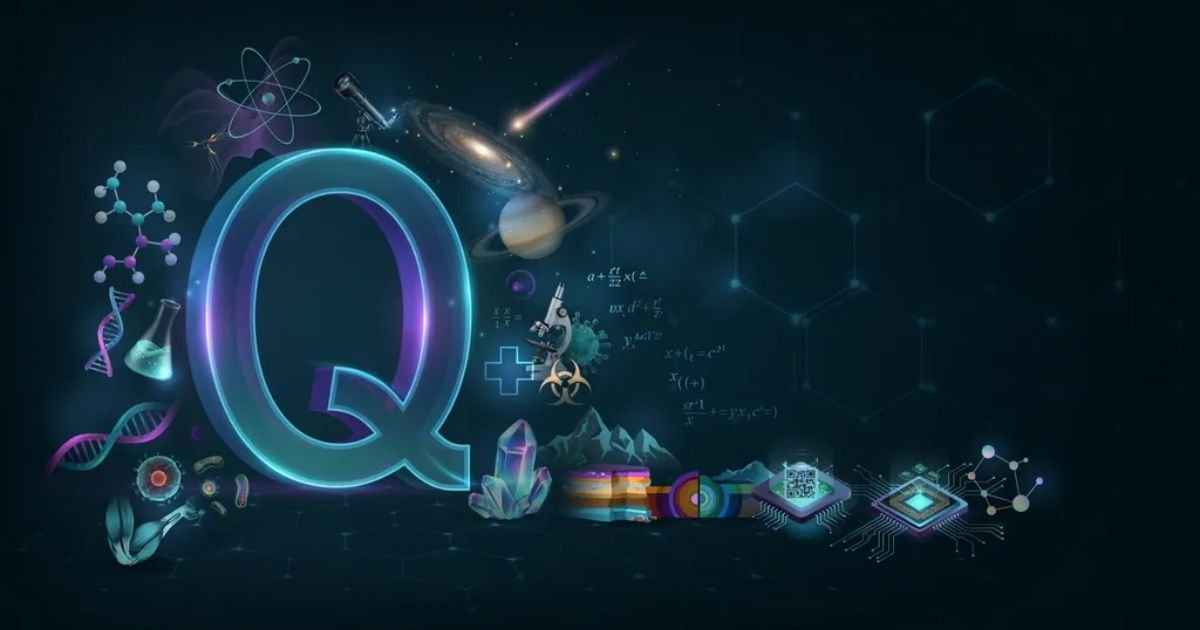
Q doesn’t get much love in the alphabet. It shows up in maybe one word out of every hundred you’ll ever read. But flip open a physics textbook or a biology journal, and suddenly this quiet little letter is carrying some of the heaviest ideas in modern science. Quantum, quark, quasar these aren’t just fun words to say. They’re the backbone of entire fields.
This guide rounds up science words that start with Q across physics, chemistry, biology, astronomy, earth science, medicine, and technology. Whether you’re studying for a big exam, building a science vocabulary list for class, or just love collecting oddball scientific terms, you’ll find real definitions here, not just dictionary fluff.
Let’s dig in.
Why Do Science Words Starting With Q Matter?
Here’s the thing about Q science terms: they punch way above their weight. Q is one of the rarest letters in the English language, yet it anchors some of the most important concepts humans have ever discovered.
Take the word quantum itself. It comes from the Latin quantus, meaning “how much.” That single root gave rise to quantum mechanics, quantum computing, and an entire branch of physics that rewired how scientists understand reality. Not bad for one small word.
Learning scientific vocabulary that starts with Q helps in a few concrete ways:
- Test prep: Q-words appear constantly on the SAT, ACT, MCAT, and science olympiad exams.
- Reading comprehension: Scientific papers assume you already know terms like qualitative and quantitative.
- Everyday literacy: Words like quarantine and quality of life show up in the news all the time.
- Career relevance: Fields like quantum computing and data science lean heavily on Q-terminology.
Mastering this corner of science terminology builds real scientific literacy, not just trivia knowledge. And because Q-words tend to cluster around genuinely advanced ideas, learning them tends to deepen your grasp of the underlying science too.
Now, let’s break these down by discipline.
Physics Science Words That Start With Q

Physics claims more Q-words than any other field, mostly thanks to quantum theory. Here’s where things get interesting.
Quantum
A quantum is the smallest discrete unit of energy or matter that can exist independently. Light, for instance, doesn’t flow in a continuous stream it arrives in packets called photons. Each photon is one quantum of light. This idea of quantized energy levels overturned centuries of classical physics.
Read This Article: Science Words
Quark
Quarks are elementary particles, the building blocks of protons and neutrons. Physicist Murray Gell-Mann named them after a nonsense word in James Joyce’s novel Finnegans Wake proof that even hard science has a sense of humor. Quarks come in six “flavors” and never exist alone in nature; they combine to form larger subatomic particles.
Quantum Mechanics
Quantum mechanics is the branch of physics describing how matter and energy behave at the atomic and subatomic scale. Unlike classical physics, it deals in probabilities rather than certainties, which is why particles can seemingly exist in two places at once until observed.
Quantum Entanglement
When two particles become quantum entangled, measuring one instantly affects the other, no matter how far apart they are. Einstein famously called this “spooky action at a distance.” It’s now the foundation of quantum encryption and quantum networks.
Quality Factor (Q-Factor)
The Q-factor measures how underdamped an oscillator or resonator is. A higher Q-factor means a system loses less energy relative to the energy it stores, which matters enormously in radio engineering and acoustics.
Quantum Tunneling
Quantum tunneling describes a particle passing through an energy barrier it shouldn’t classically be able to cross. This isn’t science fiction it’s how the sun sustains fusion and how modern flash memory chips work.
| Term | Field | Simple Definition |
|---|---|---|
| Quantum | Physics | Smallest unit of energy |
| Quark | Particle Physics | Building block of protons/neutrons |
| Quadrupole | Physics | A set of four electric or magnetic poles |
| Q-factor | Engineering/Physics | Measure of oscillator energy loss |
| Quantum Decoherence | Quantum Physics | Loss of quantum behavior due to environment |
Other worthwhile terms include quantum field theory, quantum superposition, quantum chromodynamics (the theory of the strong nuclear force), and quark-gluon plasma, a state of matter thought to have existed microseconds after the Big Bang.
Chemistry Science Words That Start With Q

Chemistry’s Q-words split into two camps: lab methodology and molecular structures.
Qualitative analysis identifies what substances are present in a sample, while quantitative analysis measures how much of each substance exists. Think of it like tasting a soup versus weighing every ingredient with a kitchen scale one tells you the flavor profile, the other gives exact numbers.
Other essential chemistry terms:
- Quenching rapidly cooling a material, often metal or a chemical reaction, to lock in a specific structure or stop a process.
- Quenching Agent the substance (often water or oil) used to carry out that rapid cooling.
- Quinone and Quinol related organic compounds important in biochemistry and dye manufacturing.
- Quinoline a nitrogen-containing organic compound used in making antimalarial drugs.
- Quaternary Ammonium compounds widely used as disinfectants and in fabric softeners.
- Quicklime (calcium oxide) a caustic compound used in construction and water treatment.
- Quasi-crystal a solid structure that’s ordered but never repeats, unlike a normal crystal lattice.
- Quartz Glass a highly pure form of glass made from silicon dioxide, prized for its heat resistance.
“Chemistry is the study of matter, but I prefer to see it as the study of change.” a sentiment that fits perfectly with quenching, one of chemistry’s most literal expressions of controlled transformation.
Biology Science Words That Start With Q
Biology’s Q-vocabulary covers everything from bacteria to muscles.
Quorum sensing is one of the coolest concepts in microbiology. It’s how bacteria “talk” to each other using chemical signals, coordinating group behavior only once their population hits a certain threshold. It’s essentially bacterial communication at a democratic scale no single cell acts until enough of them agree.
Quiescence, or a quiescent cell, refers to a cell that has paused its division cycle but hasn’t died. Cancer research leans heavily on this concept, since dormant tumor cells can “wake up” years after treatment.
Other important biology terms:
- Quadriceps the large muscle group at the front of the thigh.
- Quaternary Structure the arrangement of multiple protein subunits into one functional complex, like hemoglobin.
- Quantitative Trait a measurable biological characteristic, like height, influenced by multiple genes.
- Quasi-species a group of closely related viral variants, a concept central to understanding viral mutation and why flu vaccines change yearly.
- Quercetin a plant-derived antioxidant compound found in onions and apples.
- Q Fever a bacterial infection transmitted from livestock, which bridges biology and medicine.
Astronomy & Space Science With Q
Space science gave us one of the most famous Q-words of all: quasar.
A quasar, short for “quasi-stellar object,” is an extremely bright, distant galactic core powered by a supermassive black hole devouring surrounding matter. Quasars can outshine entire galaxies despite being relatively compact some of the brightest objects ever observed in the universe.
Other astronomical Q-terms worth knowing:
- Quadrature the position of a celestial body when it forms a 90-degree angle relative to Earth and the sun.
- Quiescent Galaxy a galaxy that has largely stopped forming new stars.
- Quark Star a hypothetical type of star even denser than a neutron star, composed of quark matter.
- Quantum Fluctuation a temporary, random change in energy at a point in space, thought to have seeded the early structure of the universe.
- Quadrantids an annual meteor shower, named after an obsolete constellation, that peaks each January.
- Quasi-periodic Oscillation recurring, near-regular fluctuations in X-ray brightness observed near black holes and neutron stars.
Did you know? Quasars were originally mistaken for ordinary stars in the 1950s because of how compact they appeared through early telescopes. It took years before astronomers realized they were looking at objects billions of light-years away, blazing with the energy of an active black hole.
Earth & Environmental Science Words Starting With Q
Back on solid ground, Q-words describe rocks, soil, and the planet’s more dangerous surfaces.
Quartz is one of the most abundant minerals on Earth, made of silicon dioxide. It shows up in sand, granite, and even wristwatches, thanks to its piezoelectric properties. A related term, quartzite, is a hard metamorphic rock formed when quartz-rich sandstone is compressed and heated over time.
The Quaternary Period is the current geological time period, spanning roughly the last 2.6 million years, defined by repeated cycles of glaciation. That leads to Quaternary Glaciation, the pattern of ice ages that shaped much of Earth’s modern landscape, and Quaternary Soil, the younger soil layers formed during this era.
Other terms worth knowing:
- Quicksand a saturated sand mixture that loses its ability to support weight.
- Quagmire a soft, boggy area of land, often used metaphorically for a difficult situation.
- Quiescent Volcano a volcano currently inactive but not permanently extinct.
- Quarry and Quarryin a site and process for extracting stone, minerals, or other materials from the earth.
- Quantitative Ecology the use of statistical modeling to study ecosystems, populations, and environmental change.
Medical & Health Science Words That Start With Q
Medicine’s Q-vocabulary tends to matter most during public health crises, but it shows up constantly in clinical work too.
Quarantine isolating people or animals to prevent the spread of disease became a household word during recent pandemics, but the practice dates back centuries, originally referring to the 40-day isolation period for ships in medieval Venice.
Other essential medical terms:
- Qualitative Diagnosis assessing symptoms and conditions descriptively rather than numerically.
- Quantitative Test a lab test that produces a specific measurable value, like blood glucose levels.
- Quinolone Antibiotics a class of antibiotics used to treat bacterial infections.
- Quality of Life (QoL) a standard measure in clinical research assessing a patient’s overall well-being, not just survival rates.
- Quasi-experimental Study a research design lacking full randomization, common when ethical or practical limits prevent a true controlled trial.
- Quackery the promotion of fraudulent or unproven medical practices, a term worth knowing if you care about public health literacy.
Technology & Applied Science Words With Q
Modern tech has adopted Q-words at a rapid pace, especially with the rise of quantum computing.
A qubit is the basic unit of quantum information, the quantum equivalent of a binary bit. Unlike a regular bit, which is either 0 or 1, a qubit can exist in superposition, representing both states simultaneously. That property is what gives quantum computers their theoretical speed advantage over classical machines.
Other tech-related Q-terms:
- Query a request for data from a database, central to nearly all modern software.
- Queue a data structure that processes items in order, like a to-do list for a computer program.
- QR Code a two-dimensional barcode that stores data, scannable by smartphone cameras.
- Quantum Encryption a security method using quantum mechanics to make eavesdropping detectable.
- Quality Assurance (QA) the process of testing software or products to catch defects before release.
- Quantum Sensor a device using quantum properties to achieve extremely precise measurements, used in navigation and medical imaging.
Easy Science Words That Start With Q
Not every Q-word needs a physics degree to understand. Here’s a beginner-friendly batch, great for younger students or a quick vocabulary refresher.
| Word | Simple Meaning |
|---|---|
| Quartz | A common, hard mineral found in rocks and sand |
| Quiet | Very little sound or movement |
| Quick | Moving fast |
| Quiver | To shake slightly |
| Quill | A stiff feather, sometimes used for writing |
| Quarter | One of four equal parts |
These make excellent starting points if you’re building a science vocabulary list for kids or reviewing basics before tackling the heavier terms above.
Advanced & Technical Science Words With Q
For readers chasing genuinely advanced scientific concepts, here’s the deep end of the pool:
- Quantum Chromodynamics the theory describing the strong force that binds quarks together.
- Quasi-particle Excitation a disturbance in a material that behaves like a particle, useful in condensed matter physics.
- Quenched Disorder a fixed, unchanging randomness within a physical system, studied in statistical mechanics.
- Quasi-equilibrium a state where a system changes so slowly it can be treated as though it’s in equilibrium at each moment.
- Quantum Optomechanics a field studying the interaction between light and mechanical motion at the quantum level.
These terms rarely show up outside graduate coursework or research papers, but they represent the cutting edge of theoretical physics and applied science.
Fun Facts About Science Words Starting With Q
A few bite-sized facts to close out the science side before we wrap up:
- Quark got its name from a nonsensical phrase in James Joyce’s Finnegans Wake, not from any scientific tradition.
- Quasar literally means “quasi-stellar” astronomers coined it because these objects initially looked like ordinary stars.
- The phrase “quantum leap” gets used loosely in pop culture to mean a huge change, but in actual physics, a quantum leap describes the smallest possible jump an electron can make between energy levels the opposite of dramatic.
- Quartz crystals vibrate at a precise, predictable frequency when an electric current runs through them, which is exactly why they’re used inside quartz watches.
- Q is one of only a handful of letters in English that almost always pairs with U except in science, where loanwords like qigong and transliterated terms break the pattern.
FAQs
What is a science word that starts with Q?
Quantum, quark, and quasar are three of the most well-known examples, spanning physics and astronomy.
What does “quantum” mean in science?
It refers to the smallest discrete unit of energy or matter that can exist, forming the basis of quantum mechanics.
What is Q in physics?
In physics, Q often refers to the Q-factor, a measure of how efficiently an oscillator retains energy, though “Q” also broadly represents quantum-related concepts.
What is a Q word in chemistry?
Quenching and qualitative/quantitative analysis are among the most common Q-terms used in chemical laboratories.
Are there many science words starting with Q?
Yes while Q is rare in everyday English, science uses it constantly, especially in physics and quantum-related fields, giving it an outsized presence in scientific vocabulary.
Conclusion
From quarks that build the universe’s smallest particles to quarantines that protect entire populations, science words that start with Q cover an astonishing range of ideas. Few letters carry this much scientific weight relative to how rarely they appear in everyday language.
Whether you’re prepping for an exam, expanding your STEM vocabulary, or just chasing a curiosity about how scientists talk, this glossary should give you a solid foundation across physics, chemistry, biology, astronomy, earth science, medicine, and technology. Bookmark it, share it with a classmate, or use it as a jumping-off point to explore each term in greater depth.
Got a favorite Q-word we didn’t cover? There’s always more to dig into science rarely runs out of things to name.
